Sit With Me, Austin
These opinions are solely my own. I am an AISD parent zoned to Webb and a former instructional coach at Dobie with a deep belief in public education. I do not speak for any groups, schools, or organizations other than ATX116, which I co-founded, and which supports this message. Work from The Preservation Project supported some of the school history research and data cited in this piece. Thank you to Nick Wong, Jessie Neufeld, and Roxanne Evans for reading this piece and making it stronger through their insights and suggestions.
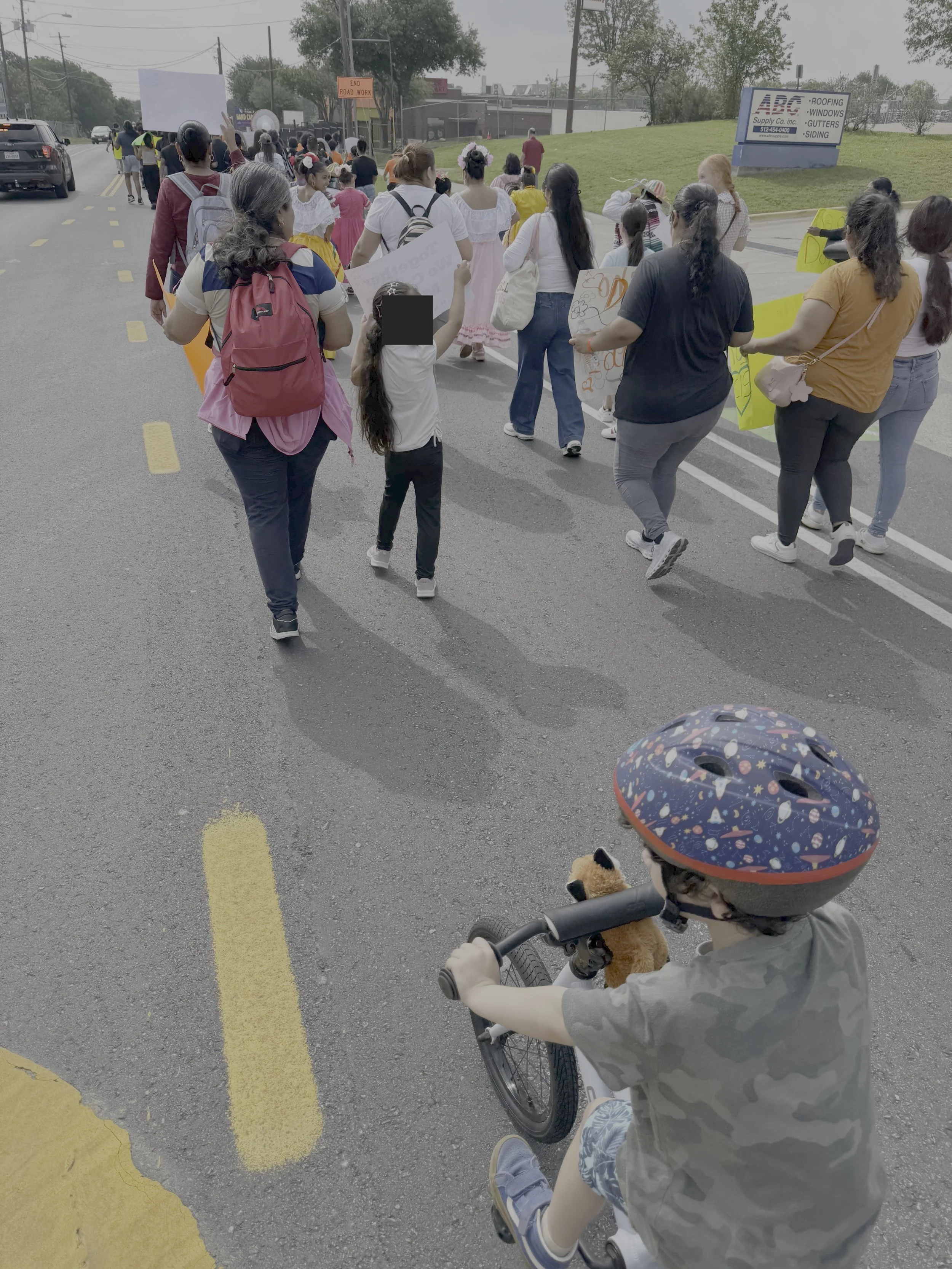
This photo was taken at the Unity Walk earlier this year. My son rode his bike the whole route, weaving through families, students, and organizers from across the district. We are zoned to Webb MS, where the walk started in 2006, the same year I first moved to Austin. As we crossed I-35 toward East St. Johns, he had no idea he was doing something political. He just knew we were all moving together down the same road.
One thing that really grinds my gears is this idea that we don't have a place in conversations about the future of our kids and schools. It's not an accident that so many of us believe that. It's what happens when your input gets filed away for years with nothing to show for it, and when "parent choice" turns out to mean choosing between two options the state already decided.
I believe in the power of holding paradox. Disagreement, grief, uncertainty, anger, hope, and very conflicting views on the path forward, all of it exists in the same room. That's part of being in a community. The Tejana scholar Gloria Anzaldúa explored the concept of nepantla — the tension of inhabiting the "in-between." For Austin parents, nepantla is the space between being a grateful public school parent and a fierce critic of the system and the state, city, and district leaders who have a responsibility to do better for our kids and community.
Growing up in a large family taught me something else: certain voices carry more weight than others. And if yours is one of them, you owe something back. Starting with listening.
That’s the first step when approaching complex problems. If you miss it, your whole trajectory can be off.
Now sit with me as I share my two cents, y'all. I'm a sixth-generation Texan, an AISD parent, and a former Dobie instructional coach. I've spent the last two decades in Austin, most of it in public service and education. That work has put me close to the structural forces shaping this moment: post-civil rights integration quietly settling back into structural segregation, active limits and attacks on voting rights, and the state redirecting public funds while punishing districts with takeovers and high-stakes testing for the outcomes that testing itself helps produce.
I have some ideas about what's happening in our city and state. I think many of us do. It's about who gets a say in the decisions that shape our schools, our neighborhoods, and our lives — and who doesn't.
Voting is one example. Texas is a political battleground, and access to the ballot is already being shaped by decisions about where, when, and how people can vote. Tarrant County recently reduced its number of polling places. ICE agents have also appeared near polling places during primaries in Texas and California, and lawsuits are seeking to keep armed federal agents away from polling places in November. Whatever your politics, fewer polling places, less notice, and increased barriers to participation do not affect everyone equally.
Here in Austin, on Sunday, September 20, an ICE officer shot Wilber Rafael Garcés Pérez, a 28-year-old Venezuelan immigrant who came to Austin seeking asylum. According to his attorney, Kate Lincoln-Goldfinch, Perez was making a DoorDash delivery to support his family and help pay for medical care for his son, who has a disability. His car was sideswiped by the ICE officer, and Austin police say he was shot in the torso. His attorney says a bullet remains lodged in his back.
These may seem like separate stories. They are not. Whether we name it or not, this is the battlefield we are living in. People are fighting to be heard, to participate, and to have some say in what happens to their communities. I don't want us to lose sight of the people whose voices are still missing when we decide who gets to vote, whose parent gets deported, whose child gets detained, and which schools stay open.
Voice & Choice
Austin ISD is one of several Texas districts staring down the barrel of a state takeover. Under Texas Education Code §39A.111, if a single campus racks up five consecutive years of an unacceptable “F” performance rating, the commissioner orders one of two things: appoint a board of managers to run the whole district, or close the campus. Since 2008, Texas has used takeover power on at least fourteen school districts, including Houston, Fort Worth, Beaumont, Connally, and Lake Worth.
There's a separate provision, §39A.112, that gives a majority of parents at a qualifying campus the option to sign a petition, and the commissioner is required to order what they ask for: a board of managers or closure. Mayor Kirk Watson is encouraging AISD parents to use that petition to close their own campuses rather than risk a full district takeover.
I understand the logic on paper. If the choice is between a district takeover, which could mean losing local control entirely, and school closures, which a community can at least initiate itself, why wouldn't families choose the option that leaves us more agency?
But the question I keep coming back to is: what kind of "choice" is that?
If you're asking families to choose whether to close the school their kids attend, and then telling those families it'll be worse under a takeover, well, that may not land. Not when many already know in their bones what it means to weather the good, the bad, and the ugly in Austin ISD. There are deeper layers of our national history, state subtext, and local context that must be taken into account.
When we examine other districts in Texas who have used this petition process, Snyder ISD parents offer a clear example. They petitioned to close their junior high in 2019; the state closed it, appointed a conservator, and required the district to reopen it, which Snyder did through a charter partner.
Rachel White, a UT associate professor of education leadership, says other Austin schools are nearing their fourth and fifth failing ratings, so closing Burnet and Webb could leave the district in the same position next year. Families could give up two schools and still face a takeover next year.
This petition shifts the burden of systemic failure onto families, dressing up a contrived choice as a noble one. The power and responsibility to address the conditions sit with the governor, the Legislature, and the commissioner, not the parents being asked to make the call.
A Pattern: From UT to AISD
Our city has a history of building what its communities need, then watching those institutions come apart when the political agendas change. UT is one example. AISD is another.
I'm a proud product of Texas public education. It was my way out of a small, conservative Texas town, and my way into the University of Texas at Austin. That gratitude doesn't blind me to what's happening at UT and other universities in Texas today. In 2023, the legislature passed SB 17, which took effect the following year and forced the layoff of around 60 UT staffers and the closure of a multicultural center on campus. In 2024, UT demolished the building that once housed University Junior High (UJH) to build a practice football facility. The building, which later became home to the Steve Hicks School of Social Work, was built in 1933. UJH became Austin's first integrated junior high in 1957, and it was still demolished even though it carried both a National Register of Historic Places designation and a Texas State Antiquities Landmark status. In 2025, SB 37 went further, handing governor-appointed boards final say over hiring UT's own vice presidents, provosts, and deans. In September 2026, UT Austin removed Mexican American and Latina/o Studies, African and African Diaspora Studies, and Women's and Gender Studies from its application options for new students.
I know this because I was there. I helped lead a partnership between my department and UT's Institute for Restorative Justice, which UT later dismantled under SB 17's DEI restrictions. I spent more than a year working in that building that once housed University Junior High (UJH) before UT tore it down in 2024. I remember carrying the last boxes out and feeling the weight of what we were losing.
I didn’t know it then, but I was standing inside a legacy this city keeps repeating: we are burying our city's history one school at a time.
I packed those boxes and moved from UT to AISD, beginning a new leadership role at Dobie Middle School in 2023. Just a couple years later, I was packing them again, displaced from Dobie by a state-required TAP restart, a "turnaround" meant to "fix" a struggling school by replacing much of its staff.
My partner and I still send our child to Austin ISD. I believe public education gives children the best chance to belong, to be known, to love, and to thrive; and to accept, to know, and to love others. My choice as a parent is to believe in public education and entrust my child to it.
There is a silent exchange I feel with my kid's school every day: Thank you for caring for my child so I can give back to my community and earn money for my family. Thank you for seeing them, teaching them, and loving them — all of them.
And the reply, in a way, is: Thank you for believing in us. Thank you for strengthening and investing in public education and our community.
That exchange runs on reciprocity and trust, even when there are real struggles within the walls or real harm within the system. I can hold both truths at once: this system fails our students by design, and it is being attacked on purpose today.
And I still believe deeply in what it makes possible.
That belief brings a particular kind of surrender and feral determination. You entrust your kid to a system being starved and set up to fail by the people running it now, and then you fight tooth and nail for what should be: a fully funded public good for all students. You keep showing up. You organize. You ask hard questions. You push back. You keep trying to make the school, the district, and the system worthy of the trust families place in them.
That is what this season feels like to me. Not a lack of faith in public education, but an enormous amount of faith in it. Enough faith to fight like hell for it.
A Familiar Fight
Families, teachers, and students should not have to carry the weight of a system-level failure. Yet, that is what we ask of them time and time again.
A Webb parent says it well. "Why do we need to sacrifice Webb and Burnet?" asked Vanessa Gamez, a parent and PTA member at Webb. She says her family has nothing left to lose if TEA takes over AISD, because for years, nobody listened when Webb families raised concerns and tried to help their own school. (KUT)
History warns us that the majority economically disadvantaged AISD campuses are more likely to close. This recurrence is especially pronounced as wealthier families move into historically Black and Mexican-American neighborhoods while the schools stay segregated by systemic outcomes.
It’s unjust. And it’s a pattern.
From L.C. Anderson (1889-1971) to Blackshear (1891-2028), Austin will have closed and consolidated 24 schools. Of the 21 schools with data, 17 schools served families and children in communities where the majority of students qualified as economically disadvantaged.
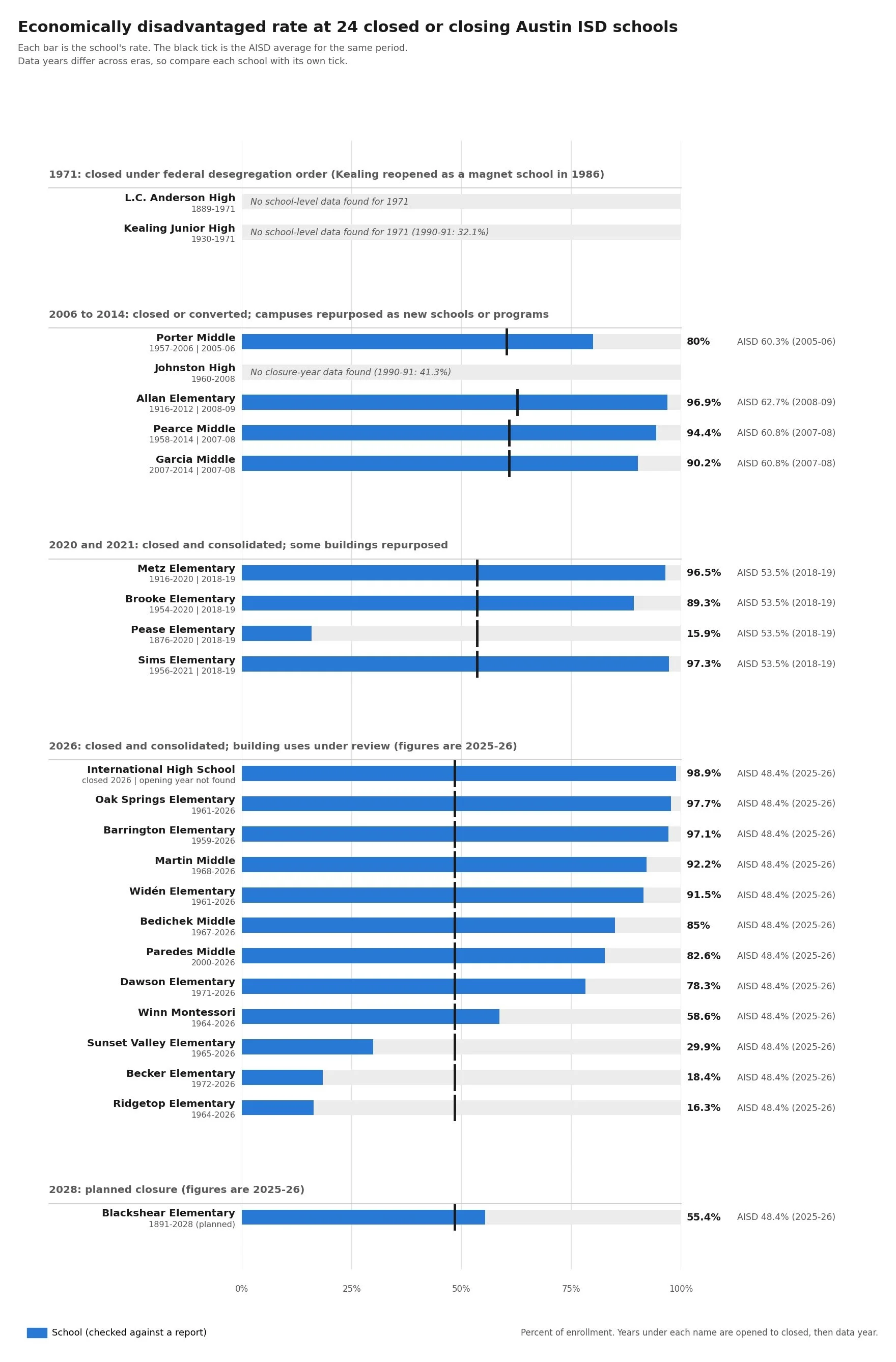
Research from The Preservation Project supported some of the school history and data cited in this piece and reflected in the graph above. AI was used to help create the image.
The graph above does not tell the full story of Austin’s school closures and consolidations. We do not have comparable data available for L.C. Anderson (1889-1971), Kealing (1930-1971), and Johnston (1960-2008). These schools, and the communities connected to them, are an important part of Austin’s history of segregation, desegregation, and educational opportunity.
Anderson and Kealing today. Kealing houses both a Magnet and an Academy program and is 37.5% white, with 23.9% of students economically disadvantaged, nearly half the district average. Eastside Early College High School, now located on the former Anderson site, serves a student population that is 76.7% Hispanic, 18.3% African American, and 89.5% of students qualifying as economically disadvantaged, well above the district average. Today, the demographics of these two campuses make clear that the story of desegregation did not end with the closing of L.C. Anderson and the movement of students across the city.
Johnston. In November 2001, the school board voted 6-3 to move the Liberal Arts Academy from Johnston to LBJ, where it merged with the Science Academy to form LASA. The move took effect in 2002-03. It left Johnston underenrolled and mostly resegregated, with five principals in two years (source: James Rodriguez, A School Divided: The History of LBJ and LASA, UT Austin Plan II thesis, 2018). In 2008, Johnston became the first school in Texas closed by the state for low test scores. It reopened that year as Eastside Memorial, split into two programs in 2009, and merged back into one school in 2011. A plan to hand it to IDEA Public Schools, a charter operator, became a rallying point for East Austin parents and advocates, who fought it off. The school later moved to the old Anderson site, and in 2021 it was renamed Eastside Early College High School at the L.C. Anderson campus. LASA now occupies the former Johnston campus.
Small pause here. If this history is hard to follow, it was hard to research and write, too. Johnston closed, reopened, split, merged, moved, changed names, and nearly got a new operator before becoming part of the L.C. Anderson legacy. Other schools went through the same churn. Allan Elementary, which was not a failing school, was handed to a charter operator, closed, left empty, and renamed. Pearce was ordered closed by the state, reopened, then converted and renamed. Webb has been on the brink three times since 2008. The pattern runs across five decades, from 1971 to 2026.
The long-term instability is systemic. But that's hard to see. Instead people form ideas about what that instability means about a place and its people. The result is that final decisions are often made by someone else other than the community: TEA, the AISD board, or a charter operator. TEA ordered Johnston and Pearce closed. The AISD board voted 6-3 to close Brooke, Metz, Pease, and Sims, and voted again in 2025 to close ten more. A charter operator nearly took over Johnston until parents organized and stopped it, but stopping a bad outcome isn't the same as having the power to design and fund a stable system.
Austin is still feeling the effects of these losses through continued school instability and fractured trust.
Austin ISD's own 342-page equity assessment, written by WestEd and presented to trustees in December 2024, found that "schools are racially and economically segregated. The report uses the Social Vulnerability Index based on census data to rate how vulnerable a neighborhood is to outside stresses. In 2022, Hispanic students made up 87.9% of enrollment at campuses rated high on the Social Vulnerability Index (Table 5, page 32). Black students are also overrepresented there compared with the district average, and Asian students are underrepresented at every campus type. White students have little to no presence at economically vulnerable schools. White students are 30.6% of the district overall but 2.5% enrollment at those campuses. Schools in Austin's most socially vulnerable neighborhoods hold only 11% of AISD's students, but 26% of its Emergent Bilingual students and 20% of its students eligible for free or reduced-price lunch. According to Austin Free Press, the district posted the report without a news release.
Austin ISD has one of the most diverse student populations in the entire country, per the Texas Tribune, but we can't keep that diversity in the same classrooms. If you have a kid in Austin ISD, you know integration and boundary conversations get real ugly, real quick. Many people hear “F-rated” and think “bad school.” But in Texas, a school’s letter grade is driven largely by STAAR scores. At Dobie, where the majority of students are emergent bilingual students, taking a high-stakes exam in English is itself a language barrier. Critics argue that the accountability system is therefore a reflection of the economic and linguistic circumstances of the students a school serves. When I served at Dobie, there were no certified bilingual educators or dual-language classes even though the majority of students' first language was Spanish. This is an opportunity gap.
We do not give students in every part of the city the same opportunities. Yes, our local education system is largely dependent on state policies and funding. But we also have to acknowledge that some of that responsibility lies with the district, and some of it lies with our city.
The District and the City
We need more coordination between the city and the district. One can't function without the other, yet we're quick to call it "an AISD problem" or "a city problem" without asking how the two overlap and work together in these areas. It took the Barrington and Oak Springs closures to show the city doesn't have a clear process for keeping council informed when the school land it jointly owns with AISD changes hands. And it took the Widén closure for Council Member Vanessa Fuentes to ask for a process where the city and AISD work together.
School closures don’t happen in a vacuum. City decisions about zoning, housing, development, and infrastructure shape neighborhoods, which in turn shape who lives there and where children enroll in school. As we examine patterns of closures, enrollment, programming, and capacity, we should also ask where public and private investment is flowing, how it changes neighborhoods, and who benefits.
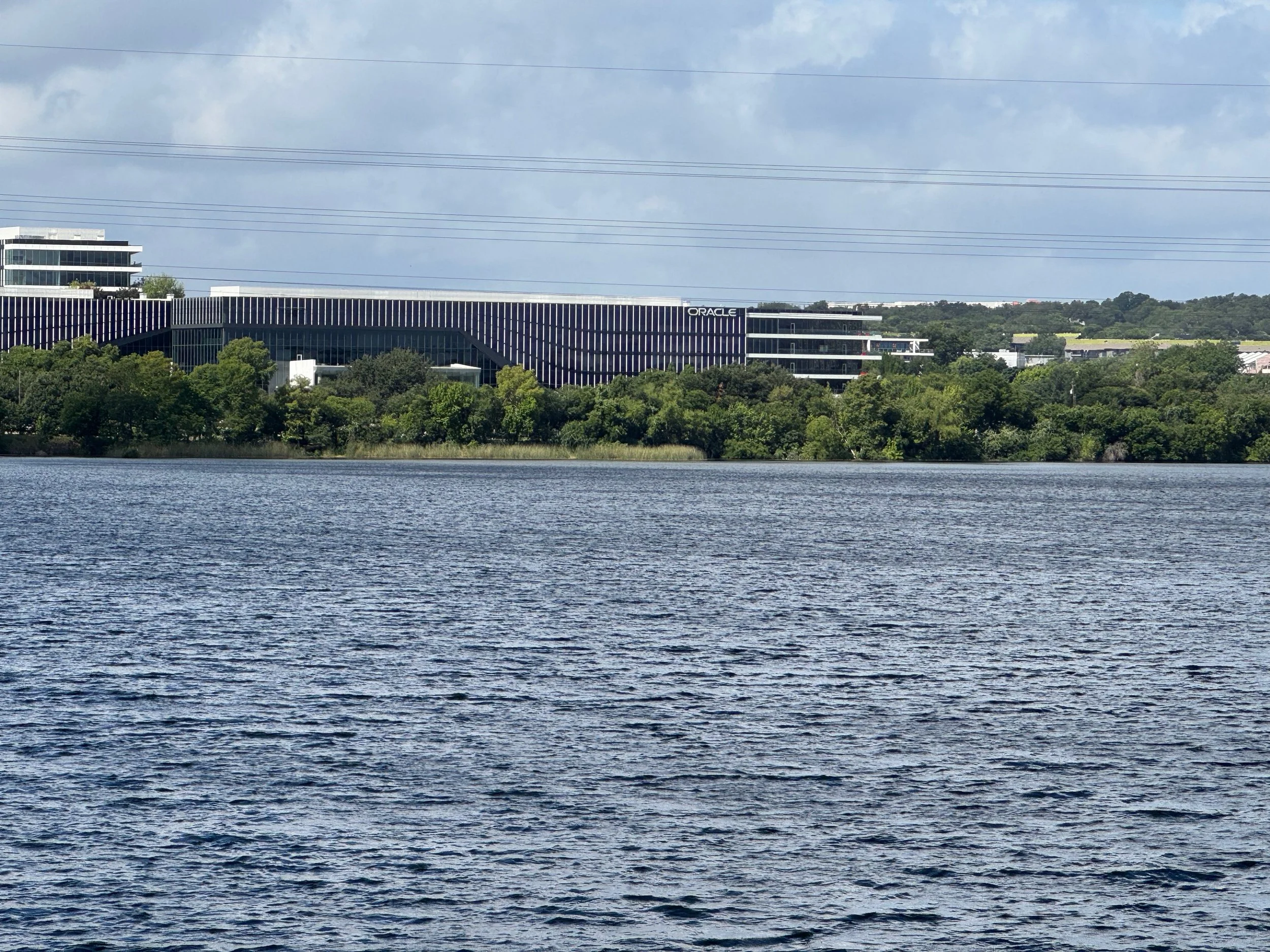
The Oracle Campus from Lady Bird Lake. The landscape has changed, but the history of what once stood here is still part of Austin’s story.
East Austin has gentrified through corporate development as well as new residents. Lakeview Apartments once stood where Oracle's Austin campus sits now. Redeveloping the property meant displacing about 200 economically disadvantaged families, according to a lawsuit that former tenants filed in 2016. The 2015 demolition displaced 121 AISD students: kids from Metz Elementary, Martin Middle School, and Eastside Memorial High School. These schools all served students who qualify as majority economically disadvantaged students.
Oracle moved its headquarters to Austin in 2020. Its chairman later said Nashville would ultimately be the world headquarters, and Oracle laid off employees in Austin in March 2026.
Before we sell our city to the highest bidder: corporate investment isn't civic commitment. Companies move. They restructure. They redirect. The people who live here and give here stay if we make an active effort to preserve our communities, starting with our schools.
Declining enrollment in historically economically disadvantaged East Austin schools cannot be understood simply as a lack of children in the community. Housing affordability, displacement and neighborhood change, family size and birth rates, and student mobility all shape where children enroll. In fact, AISD has previously acknowledged that rising housing costs and the redevelopment of historically economically disadvantaged neighborhoods have contributed to enrollment declines in Central and East Austin.
State Decisions, Local Consequences
Charter schools are also an increasingly significant part of Austin's public-school landscape. AISD’s 2023–24 demographic study found 50 charter campuses operating within the district’s boundaries and enrolling more than 18,800 students in 2022–23. A 2026 analysis from the University of Texas Education Research Center found that charter enrollment in the Austin area grew 438% between 2009 and 2025, from about 4,000 to nearly 22,000 students, while AISD enrollment declined 13% over the same period. This map from OSOD offers a useful visual of the public, charter, and private school options now available across Austin ISD zip codes.
The state, our city, and our district make it far too easy to push families out. Some families have experienced real harm in public schools. They weigh safety, inclusion, stability, and academics, and they choose what gets their child through. Morath and Abbott have made sure an exit from public schools is always close by: the free charter down the road, with transportation, where at least their kid can still go to school in the neighborhood. Or the private school that now takes vouchers, the one that gets to do the fun projects because it doesn't have to deal with STAAR or the same accountability requirements as public school.
Compare that to what we are now asking of families who stay. Nobody at a charter or private school will ever ask families to sign a petition closing their own school. But in this situation, we call that "parent choice". We call it "better than a takeover."
For whom?
We can oppose a takeover and still call the petition what it is: a contrived solution sold as a silver bullet.
Former AISD At-Large Trustee Noelita Lugo had a child at Pease Elementary when the district closed it in 2019. The AISD board voted 6-3 to close Brooke, Metz, Sims, and Pease, though Pease, unlike the others, was majority white and low-poverty, and the district gave a different reason: its historic building would cost too much to modernize. When Mayor Watson released his newsletter urging Webb and Burnet families to petition for closure, she worried those parents would feel the same pressure she once did.
"I know what it's like to have someone outside your community tell you that you need to close your school for the 'greater good,'" Lugo told the Statesman. At Burnet and Webb, more than 90% of students are low-income and more than 75% are learning English. "Between affordability issues and ICE raids and everything else, families just want to be able to send their kids to a school that's safe, where their kids can learn reading, writing, math."
Lugo joined a community meeting to help inform Webb and Burnet families about their legal options. "This is a legal right that parents have," she told KUT. Parents at the meeting asked whether their schools might stay open even under a takeover. Lugo's answer: "There's no certainty about exactly what will happen, but we do know that the schools will be forever changed."
Even if parents sign, there's no guarantee it ends there. Texas law hinges on two words here: "shall" and "may." "Shall" binds. "May" frees.
Two parts of this process are "shall". Once a campus' fifth failing rating is final, the commissioner must order a board of managers or campus closure. The commissioner's letter to AISD calls this "compulsory." A valid petition signed by the parents of a majority of students is also a "shall". The commissioner "shall order the action requested."
Everything else is "may." He may also add a conservator, a monitor, or a management team, and TEA declined to say whether that authority limits what a petition can do.
Let's be honest about what's happening.
A choice is only a choice if you have the power to say, "No." Instead, we are backed into a corner, and told to call two bad options a choice. All while our collective voice and public school funding slowly shrinks, drained out by backroom deals, ideological battles, and corruption. It's hard to see the truth through that fog. It’s hard to build bridges across neighborhoods or cities in that fog.
If you're new to Texas or new to this fight, welcome. I am so glad you're here. And I want you to know the system did not arrive here by accident.
Educating Every Child
Texas educates more public school kids than almost anywhere else in the country – more than 5.5 million of them, roughly one in every ten public school students in the United States. Frankly, educating Texan students well is a state responsibility and a national one.
Students learn best when their teachers stay. Educating them well means keeping certified teachers, paying professional educators competitively, and giving them the support to do the job. It means making sure our teachers can afford to live in the city where they teach. It means hiring more teachers who look like our students, speak their primary language, and come from their neighborhoods.
The most successful teachers and leaders I’ve seen, the ones who reach all students and stay committed through the tough times, are often the ones who grew up in the communities they serve and bring that lived experience into their teaching. They don’t have to be taught how to understand the culture, language, or community they’re serving. It’s who they are.
Educating them well means students read whole books, learn accurate and complex history (including our own city’s complex history), play outside, do arts and team sports, spend real time in libraries with librarians, go on field trips, and take on real science projects. It means ambitious goals for literacy, math, and writing. Language is the foundation of learning, and it's also the foundation of power, the tools to think critically, collaborate, and speak up for yourself and your community. It means every child is prepared not just to get into college, but to graduate from it. Those are two different things in Texas right now: access has grown, but students from economically disadvantaged communities are still far less likely to actually finish.
It means funding schools like we mean it. Texas hasn't raised its Basic Allotment, the core per-student funding amount, since 2019. Depending on whose inflation math you use, that basic allotment has lost somewhere around $1,340 in real value since then; in a class of 20 kids, that's $26,800 of funding lost.
It means keeping schools open. More than 170 Texas public schools have closed or are slated to close since 2023 alone, and that number is already closer to 200 if nothing changes.
It means keeping public school dollars in public schools. Not vouchers to private schools. Not charter expansion. Not private vendor contracts.
A concerning vision
I do not want our public schools handed to a rotating ring of consultants, operators, and political allies whose version of "support" looks like unfunded state mandates, control and fear tactics, compliance-based interventions, and the increasingly explicit influence of white Christian nationalist ideology in our public schools.
I'm naming it white Christian nationalist ideology for a reason. Here is our current Texas policy:
Every public classroom is now required to display the Ten Commandments under a law a federal appeals court upheld this year.
The state's new mandatory K-12 reading list includes Bible stories, part of the broader Bluebonnet curriculum push.
The State Board of Education just rewrote the social studies standards to center Western and Christian narratives while cutting world history, with the word "racism" removed across grade levels.
And this isn't happening in isolation. We're watching book removals, teacher speech scrutiny, restrictions on how schools can discuss race and identity, and now TEA threatening to take over districts that "facilitate" student walkouts, the same walkouts Texas students staged after ICE agents killed two American citizens in Minneapolis. In San Antonio, thirty kids who walked out got suspended and lost their extracurriculars for it.
A public education system controlled by one political ideology, where dissent is punished and communities lose their local control and elected board, is fundamentally undemocratic. And I will keep saying that out loud.
This entire situation is unacceptable, and sometimes we just have to speak the truth directly.
Yet despite it all, what keeps my hope alive?
Where the hope comes from
At the end of the day, when my feet are tired and my kids are asleep, (or when I'm in my luteal phase with a crying, potty-training toddler and an exhausted kindergartener, and I'm writing in the middle of the night because I'm already awake with sleep training and peri-menopausal hot flashes), I still have hope.
Partly because I'm seeing something I haven't seen enough of in ten years: pissed-off Texas women, moms, and teachers using their voices. Giving more than a few choice words in public testimony. Showing up at school board meetings. Organizing their communities. Demanding policy that actually funds public education.
So how do we inspire more people to find their gumption and grit? How do we make room for people who are tired, angry, scared, skeptical, or still figuring out what they believe? And, by golly, how do we keep giving a damn about our public education system after these immediate takeover battles and this election cycle? Because this fight was never only about budgets or buildings. It is about who gets access to what, and who has been asked to accept less.
As writer and civil rights journalist Nikole Hannah-Jones puts it, reflecting on her decision to send her own daughter to a segregated, high-poverty school:
“We desire to be let off the hook by these realities — that we tried and we failed; by the shamble of decades of halfhearted efforts; by how insoluble it is to achieve equality in a nation with our history. Instead of fortifying our determination to fight for integration, we have instead chosen to succumb to a collective apathy in the face of a system so devastatingly unequal that it puts at odds trying to be a good person with trying to be a good parent.
But for all of our justifications, including mine, an undeniable verity remains. As long as we continue to rescue our own children from the failing schools where we allow other people’s children to languish simply because those children have been born Black and poor in a nation of racism and riches, there is no absolution here. Not for me. Not for you. Not for any of us.”
— Nikole Hannah-Jones, In Fighting for Every Black Child, Did I Betray My Own? - The New York Times
We must listen to the people who have been telling us this story. Vanessa Gamez, a parent and PTA member at Webb Middle School, told KUT News that "nobody listened to us."
We've been talking. You just haven't been listening.
Maybe Austin's job right now is to sit with the story of our city long enough to truly understand it. To be vulnerable enough to recognize where we have gotten it wrong, where we have fallen short of our civic duties, and to let that truth change what we do next.
This is our collective responsibility, not work that falls on one school or one parent. It requires consistent participation and critical dialogue. And in that process, trusting that people know what’s best for their kids and their communities. Whether they are saying no to a petition or looking for what they believe is a “good” school somewhere else, they are making choices based on needs: safety, community, belonging, cultural representation, academic opportunity. The tragedy is that these have become choices at all.
And when we still get it wrong, because we're human, I hope we're wise and humble enough to listen when people tell us. To adjust. To try again.
That is the Work: before voting and after voting, before a takeover and after a takeover. Before a policy is written and after it reaches the people who have to live with its consequences.
Austin's story is part of the larger story of public education in Texas and across the country. The challenges we face did not begin with one election or board. They have accumulated across decades, and this immediate fight is for 5.5 million students in Texas public schools. As the saying goes, "There is no such thing as someone else's child."
So when it’s time to make your choice in November, use your voice: vote. Keep the students, schools, communities, educators, and families at the center, and encourage the people around you to do the same.
And don’t lose sight of the larger forces at play in this fight for public education. This is not ultimately about Burnet or Webb, or even just about Abbott and Morath. They are part of the story, but they are not the whole story.
No matter what happens in November, keep showing up. Listen to your neighbors, especially when they see things differently than you do.
None of this is simple. That is the paradox I asked you to sit with at the start: we can be grateful for our schools and demand the system do better for all of them, and do better ourselves, in the same breath.
As James Baldwin said, "I love America more than any other country in the world, and, exactly for this reason, I insist on the right to criticize her perpetually."
The future of our public schools belongs to all of us: the students and families who rely on these schools, the educators who carry them, the communities that surround them, and the neighbors who choose to stay committed.
What happens next depends on what we choose to commit to, question, and protect, even when it would be easier to look away.
That's how we change, and are all changed, for the better.
H. E. Wong (she/they) is a queer and neurodiverse writer, storyteller, and ICF-credentialed professional coach based in Austin, Texas. They write, direct, and produce oral history, documentary work, essays, and public testimony, with a focus on the stories and perspectives institutions tend to overlook.